found.
I found the mushroom. I found the truth. They found me.
Some mysteries are inherited. Others are experienced.
What if the oldest religious stories were maps of consciousness?
The mushroom
I learned respect before certainty.
I wrote about the mushroom as an encounter: beautiful, demanding, sometimes terrifying. In the forest I admired its presence, color, symmetry, scent, and its place in the living earth.
A powerful experience can open wonder and fear at once. The revelation is not the end. Learning how to live with it is part of the path.
What if the mushroom is not an answer, but a door?
This is a symbolic inquiry, not a claim that mushrooms explain the historical origin of Christianity or any religion.
The true bread
Across years and names, I kept returning to the image of sacred food.
- Bread from heaven
- Hidden manna
- Fruit of knowledge
- A body eaten
- A cup consumed
- The Tree of Life
I read these images as ritual, metaphor, sacrament, memory, and mystery. I wondered whether the fruit, manna, bread, and cup preserved the outline of an encounter.
That is my interpretation—not established history, and not proof.
Taste and see.
Perhaps religion begins not with believing something—but with encountering something.
Three days
The path was never bliss alone.
I wrote from the shadow too: anger at the world, terror, death imagery, and the feeling that consciousness had crossed a threshold.
Those experiences were real to me as experiences. Their meaning remains open. Visionary states can be profound and destabilizing; care, trusted support, and integration belong beside any spiritual interpretation.
- Descent
- Silence
- Death
- Rebirth
- Return
Die before you die.
The serpent
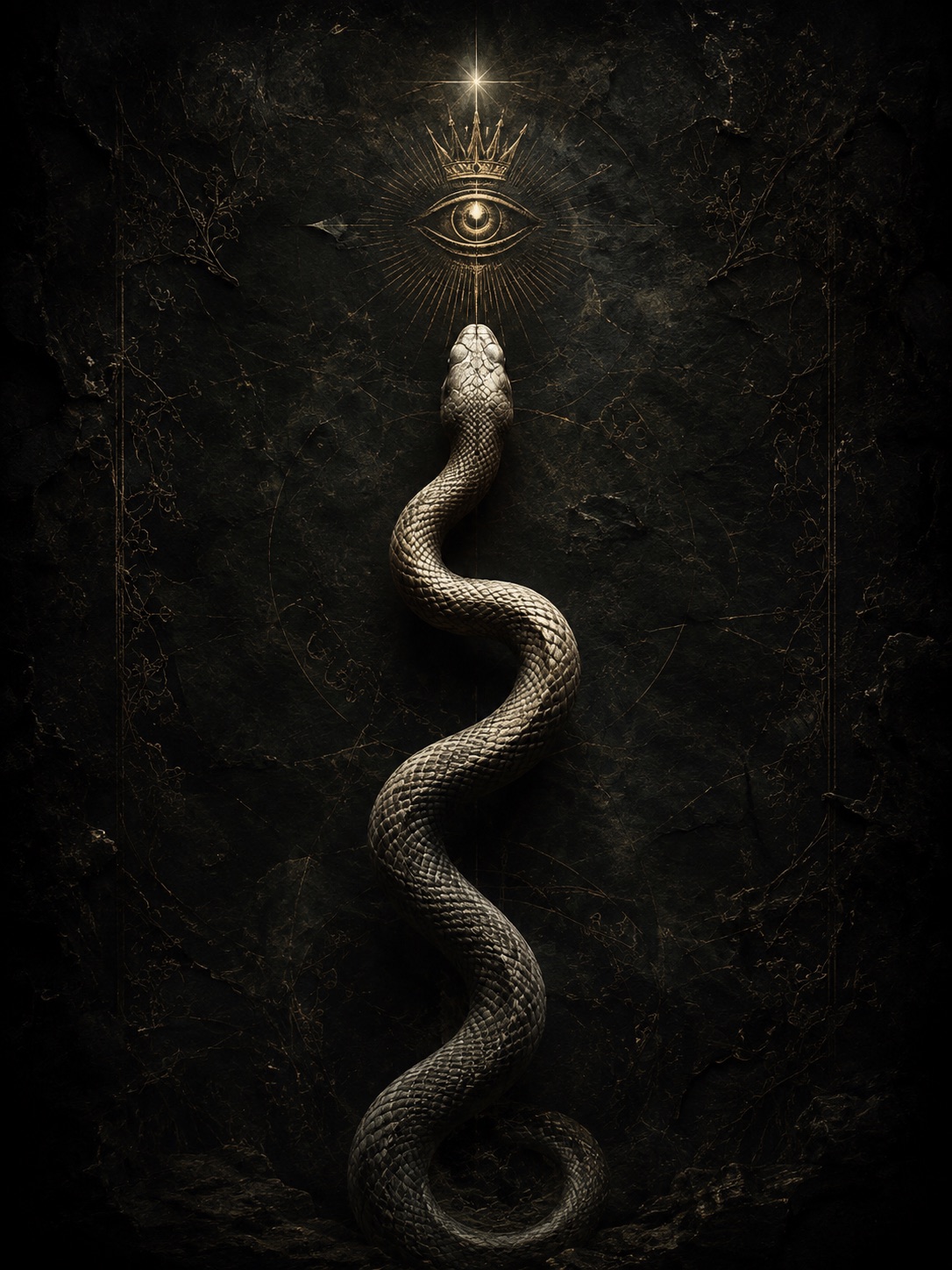
Poison and medicine. Death and regeneration. Wisdom and deception.
In Genesis the serpent is cursed. In the wilderness, a bronze serpent becomes an image of healing. Later: “As Moses lifted up the serpent…”
The symbol refuses to stay still. It rises toward eye, crown, and light—danger transformed into vision.
Gnosis
I kept circling one question: what is it to know rather than believe?
I wrote about what exists, what does not, the Self, and the strangeness of simply being. The questions survived longer than the answers.
Gnosis names direct knowing. In my writing, the kingdom within became a door in consciousness—approached through contemplation, crisis, dream, art, and visionary experience.
The kingdom is within.
Hidden manna
A white stone. A new name. Food concealed from ordinary sight.
Revelation leaves images that can be read literally, mystically, psychologically, or entheogenically. The last reading is speculative, not consensus.
I kept asking whether mysteries disappear because institutions hide them, because language fails them, or because some meanings remain illegible until they are lived.
What was lost?
What was found?
The record
The experience began in 2006. Before found. had a name, I left the signal in public.
The posts change in tone, but the questions return: mushroom and Christ, death and rebirth, hidden meaning, direct experience, the fear of being misunderstood, and the difficult work of bringing a revelation back into ordinary life.
I wrote from the shadow: death, resurrection, anger, fear, and experiences I could not yet integrate.
I wrote from the forest: reverence for the mushroom, the balance of being, ancient initiation, and the humility to admit I was not ready.
I wrote from the signal: Christ, sacred food, hidden meaning, ascent, persecution, and the possibility that the mushroom could become a language for direct experience.
One person trying to understand one encounter. I preserve the questions, not every conclusion.
I found the mushroom.
I found the truth.
They found me.
Before the church
Experience came first. The investigation followed.
Christianity emerged in a world of mystery traditions, visionary practices, ecstatic states, sacred meals, prophecy, healing, and initiation.
Researchers disagree about whether psychoactive substances played any role. The evidence is incomplete, and entheogenic theories of Christian origins remain speculative.
My posts returned often to John Allegro and entheogenic readings of scripture. I treat those ideas here as symbolic and speculative, not as settled scholarship.
found. explores archaeology, comparative religion, psychedelic phenomenology, symbolism, and personal experience without turning possibility into certainty.
This is an investigation.
Not a creed.
The reversal
Again and again, I asked whether an encounter became a ritual—and the ritual became an explanation.
The cup. The bread. The serpent. The halo. The crown. The eye. I inherited the symbols and kept asking what encounter first gave them power.
The map survived.
Did we lose the territory?
The crown
I described the experience in spatial language: rising, opening, being found above the ordinary self.
At times the language was electrical, bodily, and cosmic. I record it as the language of an altered state—not as anatomy, supernatural proof, or a claim others must accept.
What happens when the lost one returns from above?
The eye
To write a vision is not to prove it.
I wrote about presences, voices, shared consciousness, providence, the witness, and the feeling of being seen. They may be read as mystical encounter, psyche, symbol, altered perception, or something unresolved.
We are waking up.
Follow the thread
The archive is not a finished doctrine. It is a record of one person trying to name what happened.
My writing is testimony and interpretation. Researchers disagree sharply about entheogenic theories of Christianity, and visionary experiences can have psychological as well as spiritual meanings. These subjects are paths for investigation, not authorities assembled to prove a creed.